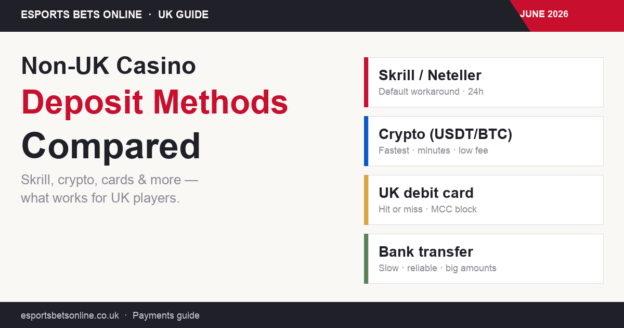
Getting money into an account is often the first practical question UK players have about non-UK casinos. This guide compares the main payment methods on speed, fees, withdrawal rules and verification. One thing up front: many UK banks let you block gambling transactions, and that block is a safety feature. If you have chosen to block gambling on your account, please keep it that way.
This guide explains which payment methods actually work for UK players at non-Gamstop sites, the fees and speeds you should expect, and the order in which to try them. The short version: Skrill and crypto are the most reliable, debit cards are hit-or-miss depending on your bank, and prepaid options exist as fallbacks for both.
Key takeaways
- Skrill and Neteller are the most reliable methods for UK players — accepted at almost every non-Gamstop site, fees usually under 2%.
- Crypto (BTC, ETH, USDT) is fastest for both deposits and withdrawals, with the lowest fees, but requires you to already hold or buy crypto.
- UK debit cards work at some operators, but Lloyds, Monzo, Starling, and Nationwide block international gambling MCCs by default. If a block is on your account, treat it as a safeguard.
- Withdrawal method usually has to match deposit method. Plan for the withdrawal at deposit time — not afterwards.
- All winnings remain tax-free for UK residents regardless of the deposit method.
The deposit method landscape, by tier
Sorting payment methods by practical reliability for UK players at non-UK casinos in 2026:
| Tier | Method | Deposit speed | Withdrawal speed | Typical fee | UK reliability |
|---|---|---|---|---|---|
| 1 | Skrill | Instant | 1–24 hours | 0–2% | Excellent |
| 1 | Neteller | Instant | 1–24 hours | 0–2% | Excellent |
| 1 | Bitcoin / Ethereum | 10–60 min | 10–60 min | 0–1% | Excellent (if you have it) |
| 1 | USDT / USDC | 5–30 min | 5–30 min | 0–1% | Excellent |
| 2 | UK debit card (Visa/Mastercard) | Instant if approved | 3–5 business days | 0–3% | Variable — bank-dependent |
| 2 | Apple Pay / Google Pay | Instant | N/A (refund path) | 0–1% | Variable — bank-dependent |
| 3 | Direct bank transfer (SEPA, Faster Payments) | 1–24 hours | 1–3 business days | 0–1% | Reliable but slow |
| 3 | Paysafecard | Instant | N/A (alt method required) | 0% | Good — fallback option |
| 4 | Prepaid debit card | Instant if approved | 5–10 business days | 2–4% | Last resort |
The pattern is clear: e-wallets and crypto sit at the top because they were built around the friction UK card issuers added. Cards work when they work but you can’t rely on them as the only option.
Why UK debit cards often fail
Card payment processors classify merchants with Merchant Category Codes (MCCs). Gambling sites fall under MCC 7995. Since 2020, the UK regulator banned credit cards for UK-licensed gambling — but UK card issuers extended this on their own initiative to all international gambling MCCs, including offshore casinos.
Several UK banks and card providers, including Monzo, Starling, Barclays and Lloyds, let customers block gambling transactions in their app or by phone. Turning a block off usually involves a cooling-off period (Monzo, for example, uses 48 hours), and that delay is there on purpose.
If you set up a gambling block yourself, we strongly recommend leaving it on and not trying to get around it with other payment methods. It is one of the most effective tools against problem gambling. If you are unsure, the National Gambling Helpline (0808 8020 133) can talk it through with you.
Skrill and Neteller (e-wallets)
Both Skrill and Neteller are owned by Paysafe Group. They’re functionally similar e-wallets that sit between your bank and the casino: you fund the wallet from your bank account (or card), and use the wallet balance to deposit at the casino.
Why they work well for non-Gamstop play:
- Accepted at 95%+ of non-Gamstop sites — among the highest acceptance rates of any payment method
- Withdrawals processed in 1–24 hours, well ahead of card refund timelines (3–5 days)
- GBP, EUR, USD support — no currency conversion if you fund the wallet in GBP and the casino accepts GBP via Skrill
- Independent KYC with Skrill once, then carries across to any operator
A note on bank gambling blocks: if you have switched on a gambling block with your bank, it is there to protect you. Please do not use e-wallets or other methods to work around it. If you want extra protection, combine it with blocking software such as Gamban, and see our Responsible Gambling page.
What to watch:
- Bonus eligibility: Many operators exclude Skrill and Neteller deposits from welcome bonuses. Check the bonus T&Cs before depositing if you want the bonus.
- Inactivity fee: Skrill charges €5/month after 12 months of inactivity. If you only play occasionally, withdraw any balance to your bank when you finish.
- Wallet-to-casino fee: Usually free, but some operators pass a 1–2% fee. Worth checking.
Crypto — fastest method, learning curve included
Bitcoin, Ethereum, and stablecoins (USDT, USDC) are increasingly the default at newer non-Gamstop sites. The pitch is straightforward: instant deposit, instant withdrawal, near-zero fees, and your UK bank never sees a gambling transaction at all.
What works well:
- USDT on Tron (TRC-20) is the fastest — confirmations in 1–2 minutes, network fees under £1
- BTC and ETH are universally accepted but slower (10–60 min confirmations) and network fees higher (£2–10)
- No bonus exclusions at most crypto-friendly sites — crypto deposits are usually eligible for full welcome offers
The learning curve:
- You need to buy crypto first — UK exchanges include Coinbase, Kraken, Bitstamp. KYC + bank transfer + crypto purchase adds 30–60 minutes the first time.
- You need a wallet to hold the crypto — exchange wallet works for direct transfers, but a personal wallet (MetaMask for ETH/USDT, electrum for BTC) gives you more control.
- Withdrawals come back to your wallet. If you want GBP, you need to send back to the exchange and sell. Adds 1–2 days and 1–2% to the full cycle.
For UK players who already hold crypto, it’s the best method by a wide margin. For UK players starting from a GBP bank account, Skrill is faster end-to-end for one-off play.
Direct bank transfer — slow but reliable
SEPA bank transfer (for EUR) and Faster Payments (for GBP) are accepted at most non-UK casinos. They work the way you’d expect — you push money from your UK bank to the operator’s banking partner, the operator credits your casino balance.
- 1–24 hours for deposit credit, 1–3 business days for withdrawal
- No fee on UK side; some operators charge €1–5 for bank transfer processing
- Higher transaction limits than card or e-wallet methods — relevant if you’re depositing £1,000+
Bank transfer is the right choice for large one-off deposits where speed isn’t critical and bonus eligibility doesn’t matter. For everyday play, the 24-hour delay makes it a poor first choice.
Withdrawals — plan at deposit time
Almost every non-Gamstop site enforces a “closed loop” policy: withdrawals go back via the same method you deposited. This is partly anti-money-laundering compliance, partly business protection.
What this means in practice:
- Deposit by card → withdrawal goes back to the same card as a refund. 3–5 business days. The closed loop is enforced even if you’ve also added an e-wallet later.
- Deposit by Skrill → withdrawal goes back to Skrill. Same-day to 24 hours. Fast.
- Deposit by crypto → withdrawal goes back in crypto. Minutes to hours.
- Deposit by Paysafecard → no withdrawal path. You’ll need to add a withdrawal-only method (usually bank transfer) before any payout.
The practical implication: if you care about withdrawal speed, deposit with the method you want to withdraw with. Don’t deposit by card thinking you’ll withdraw to Skrill — most operators won’t let you.
KYC and what each method requires
All non-Gamstop sites require KYC (Know Your Customer) verification before processing a withdrawal. The level of paperwork varies by deposit method:
- Skrill / Neteller: You verify once with Skrill itself. Casinos typically accept that verification, so a UK passport or driving licence + proof of address gets you through.
- Card: ID, proof of address, and a photo of the card (front + back, with middle digits and CVV obscured) at most operators.
- Crypto: Usually lightest — ID and proof of address, no transaction verification required (since the blockchain provides it). A few operators ask for source of crypto documentation for large amounts.
- Bank transfer: ID, proof of address, and a bank statement showing the transfer originated from an account in your name. Stricter than other methods.
Complete KYC before you play — not after a big win. Operators delay payouts pending KYC routinely, and the 24–72 hour verification window after a win feels much longer when your money is locked.
Red flags at deposit time
- Crypto-only sites with no published licence. Crypto is fine; combined with no regulator visibility, walk away.
- Operators that ask for card details before deposit. Reverse of the normal flow. Real operators take your deposit through the cashier; they don’t ask for card details to “register your card.”
- Deposit method fees over 5%. Standard processor fees are under 2%. Anything above that is a margin grab on you.
- “Recommended” payment methods that aren’t on the regulator’s accepted list. Some operators steer players toward obscure payment methods that don’t have UK consumer protection (e.g. “Instant deposit via voucher code”). Real e-wallets and crypto don’t need to be steered.
FAQs
Will my UK bank flag a Skrill or crypto deposit as gambling?
Often not, because the payment goes to an e-wallet or a crypto exchange rather than directly to a gambling merchant. That is exactly why these methods can undermine a gambling block you have chosen. If you have a block on your account, please don’t use them to get around it.
Do I pay tax on winnings if I deposit and withdraw in crypto?
Personal gambling winnings remain tax-free for UK residents regardless of method. However, if you hold winnings in crypto and the crypto’s value rises before you sell, the gain on the sale is potentially subject to Capital Gains Tax. The gambling winnings themselves are still tax-free.
Can I deposit at a non-UK casino using Apple Pay or Google Pay?
Sometimes, yes. Apple Pay and Google Pay both pass through your underlying card, so the same MCC blocks apply. If your UK card is blocked for gambling MCCs, Apple Pay or Google Pay won’t bypass that. If your card is open, they work normally.
What if my card is declined despite the gambling block being off?
Try a different card type if you have one. Some operators only accept Visa or Mastercard but not Maestro/Visa Electron. If the issue persists across multiple cards, switch to Skrill or crypto — the operator’s card processor relationship is likely the limiting factor.
Is there a deposit method that’s completely anonymous?
No. Every non-Gamstop site requires KYC before withdrawal regardless of deposit method. Paysafecard and crypto can deposit anonymously at the wallet level, but the casino still verifies your identity before paying you out. Treat any operator that claims “anonymous withdrawals” as a red flag.
How fast is the typical withdrawal end-to-end?
Best case (crypto, already verified): under 30 minutes. Standard case (Skrill, verified): same day. Slow case (card or bank transfer, fresh KYC): 5–7 business days. Most published “instant withdrawal” claims are honest about the post-KYC speed, not the total time from request.
Are deposits via crypto reversible?
No. Once a crypto transaction is confirmed on the blockchain, it cannot be reversed. Card transactions, by contrast, can be charged back with your bank’s help if an operator refuses to release legitimate winnings. This is a non-trivial reason some players still prefer cards despite the friction.
What’s the minimum deposit at most non-Gamstop sites?
£10 / €10 is standard. Some crypto-focused sites go as low as €1 equivalent. Look for sites with low minimum deposits if you’re testing the platform before committing.
Bottom line — the recommended order to try
If you’re depositing at a non-UK casino for the first time, try the methods in this order:
- Skrill or Neteller — most reliable, accepted everywhere, Set up the wallet, fund it from your bank, and deposit. Plan on 30 minutes the first time, 30 seconds every subsequent time.
- Crypto (USDT-TRC20 or BTC) — if you already hold crypto, fastest end-to-end. If not, only worth setting up if you’ll play more than once.
- UK debit card — if your bank allows gambling transactions on the card. Fast if it works; reliable backup needed if it doesn’t.
- Bank transfer — only for large deposits where 24-hour delay is acceptable.
- Paysafecard or prepaid card — as last-resort deposit; requires a separate withdrawal method anyway.
For ongoing play, settle on one primary method (most UK players land on Skrill) and one backup (most land on crypto). The 5 minutes you spend setting up the secondary saves you when your primary fails on a Saturday night.
For background on the operators that accept these methods, see our non-UK casinos overview and non-Gamstop casinos list. If you’re new to the non-Gamstop space, start with our What Are Non-Gamstop Casinos guide. And before claiming any welcome offer, check the wagering reality breakdown in our no deposit bonus codes guide.