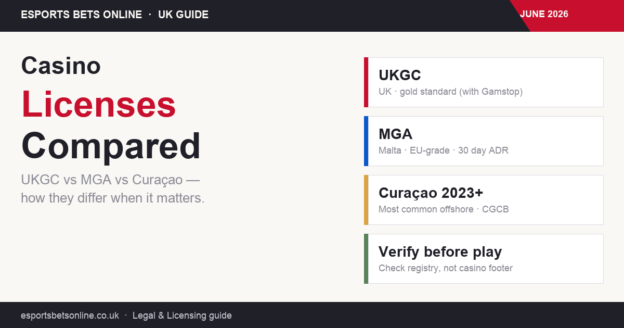
When you play at a non-UK casino, the licence at the bottom of the page isn’t decoration — it’s the only thing standing between you and a refused withdrawal with no path of appeal. Different licences offer wildly different levels of player protection, dispute resolution speed, and operator accountability. Knowing which licence sits behind a casino is more important than the welcome bonus, the game lobby, or anything else on the homepage.
This guide walks through the three licences UK players encounter most often — Curaçao eGaming, the Malta Gaming Authority (MGA), and the UK Gambling Commission (UKGC) — and explains what each actually means when something goes wrong.
Key takeaways
- UKGC is the gold standard but comes with affordability checks, stake caps, and Gamstop integration. Not relevant to non-Gamstop sites.
- MGA (Malta) offers EU-grade player protection and a formal Alternative Dispute Resolution (ADR) process — typical complaint resolution within 30 days.
- Curaçao eGaming is the most common offshore licence. Cheap to obtain, fast to issue, and historically slow at handling player disputes — but a 2023 regulatory overhaul tightened things.
- The single most important question to ask: “How does this licence handle complaints, and how fast?” The answer ranges from “in 30 days via an EU ADR body” (MGA) to “send an email and hope” (some Curaçao master licence holders).
The three licences at a glance
| Feature | UKGC | MGA (Malta) | Curaçao eGaming |
|---|---|---|---|
| Established | 2007 | 2001 | 1996 (overhauled 2023) |
| Cost to operator (rough) | £25,000+ application + ongoing fees | €25,000+ application + ongoing fees | €20,000–30,000 (master) / €5,000 (sub) |
| Player fund segregation | Mandatory | Mandatory | Required since 2023 overhaul |
| Mandatory ADR / dispute body | UKGC + IBAS | MGA Player Support Unit | CGCB (Curaçao Gaming Control Board) since 2023 |
| Typical complaint resolution | 30–60 days | 15–30 days | 30–90 days (varies by licensee) |
| Affordability checks | Required above thresholds | Operator discretion | Operator discretion |
| Game RTP audit | Required + published | Required + published | Required by certified labs |
| Self-exclusion register | Gamstop (cross-operator) | Operator-level only | Operator-level only |
| Marketing in UK | Permitted | Permitted under conditions | Restricted |
Curaçao eGaming — what changed in 2023, what didn’t
Curaçao is the licence behind roughly 70% of non-Gamstop casinos UK players encounter. For two decades, it had a deserved reputation as a budget licence: cheap, fast, and largely toothless against operators who refused to pay out.
That changed with the Landsverordening op de Kansspelen (LOK) overhaul, implemented in stages from 2023. Key changes:
- The old “master licence + sub-licence” structure was abolished. Previously, four master licensees (Cyberluck, Curaçao Interactive Licensing, Antillephone, Gaming Curaçao) issued sub-licences to operators with minimal oversight. Now, every operator must hold a direct licence from the Curaçao Gaming Control Board (CGCB).
- Player fund segregation is now mandatory. Operator funds and player balances must be held in separate accounts.
- Formal complaint process via the CGCB. Players can file directly with the regulator if an operator refuses to resolve a dispute.
- KYC and AML requirements aligned with FATF standards. Operators are now liable for failure to meet AML obligations.
What didn’t change: Curaçao licensees are still under no obligation to publish RTP variance data, host an EU-based player support team, or join cross-operator self-exclusion schemes. The CGCB complaint process exists but, as of 2026, resolution times average 30–90 days depending on operator cooperation.
Practical impact for UK players: Curaçao-licensed casinos established after 2023 are notably better-regulated than the pre-2023 cohort. Check the operator’s licence date — anything older than mid-2024 may still be operating under transitional terms. The licence number on the casino footer should resolve to a live entry on the CGCB register at gamingcontrolcuracao.org.
Malta Gaming Authority — the EU-grade option
The MGA is the regulator most often cited as offering “near-UKGC” player protection without the affordability checks and Gamstop integration. For UK players moving to non-Gamstop sites, an MGA-licensed operator usually represents the highest practical standard available.
Three things make MGA stand out:
- The MGA Player Support Unit. If your dispute with an operator can’t be resolved bilaterally, you escalate to the MGA. They have a published 21-day initial response target and a 60-day final decision target. Decisions are binding on the operator.
- Mandatory player tools. MGA-licensed operators must offer deposit limits, session reminders, time-outs, and individual self-exclusion. These aren’t optional or buried in a help page — they’re required to be one click from the cashier.
- Published licensee register with status. You can search any operator at mga.org.mt and see real-time licence status (active, suspended, surrendered). UKGC and Curaçao have registers too, but MGA’s is the most usable.
The trade-off: MGA-licensed operators tend to be more expensive to run, so welcome bonuses can be slightly less aggressive than at Curaçao-licensed rivals. You’re paying a small premium in offer size for substantially better dispute infrastructure.
UK Gambling Commission — the reference point
The UKGC is included here as a reference, not a recommendation for non-Gamstop play. UKGC-licensed operators integrate with Gamstop by law — by definition, no UKGC casino is a non-Gamstop site.
What makes UKGC the strongest licence on paper:
- Frictionless affordability checks introduced in 2023–2025, requiring operators to verify financial vulnerability above set deposit thresholds.
- £5-per-spin stake cap on online slots for players under 25, with a £2 cap for under-25s introduced in late 2024.
- IBAS (Independent Betting Adjudication Service) as a free, independent dispute resolution layer in addition to UKGC oversight.
- Full Gamstop integration for cross-operator self-exclusion.
These rules are what UK players give up when they choose a non-Gamstop site. Whether that trade-off is worth it depends on whether you actually want the protections, or whether you find them restrictive. The honest answer is “both, in different contexts” — and the reason a non-Gamstop market exists at all.
The dispute resolution test — what actually happens when things go wrong
The clearest way to judge a casino licence isn’t to read the regulator’s mission statement — it’s to look at what happens when an operator refuses to pay out a legitimate win.
UKGC scenario: Operator refuses payout citing T&C breach. You file with UKGC + IBAS. IBAS issues a binding decision within 60 days. UKGC can fine the operator if pattern of refusal emerges. Strong recourse.
MGA scenario: Operator refuses payout. You exhaust the operator’s internal complaint process (28 days). Escalate to MGA Player Support Unit. They review evidence both sides, issue binding ruling within 60 days. Operator non-compliance can trigger licence review. Strong recourse.
Curaçao (post-2023) scenario: Operator refuses payout. You complain to the operator. If unresolved, you file with the CGCB. They will request operator response. Resolution time 30–90 days depending on operator cooperation. Outcomes have improved markedly since 2023 but enforcement is still less predictable than MGA. Moderate recourse.
Other offshore licences (Anjouan, Costa Rica registration, “internationally regulated”): You email the operator. If they don’t respond, your options are limited to public reviews and disputes with your payment provider (chargebacks, where possible). Weak to no recourse.
Other licences UK players occasionally encounter
- Kahnawake Gaming Commission (Canada). Long-established (1996), credible regulator on Mohawk First Nations territory. Smaller licensee pool than Curaçao, generally good complaint handling but slow to respond. Worth considering if you find an operator with this licence.
- Anjouan Gaming (Comoros). Emerging budget licence positioned as a cheaper alternative to post-2023 Curaçao. Limited track record on enforcement. Treat as approximately equivalent to pre-2023 Curaçao — proceed with caution.
- Costa Rica business registration. Technically not a gambling licence at all — Costa Rica licenses gambling operators as ordinary companies with no specific oversight. Operators that claim a “Costa Rica licence” are effectively unregulated. Walk away.
- Gibraltar, Isle of Man. Strong regulators with EU-grade oversight, but most of their licensees serve UK customers via UKGC dual-licensing, so you’ll rarely encounter these at non-Gamstop sites.
How to verify a licence is real
Every legitimate online casino publishes its licence number, usually in the footer. Verifying takes 60 seconds:
- Find the licence number on the casino page. Should look like “Licence #1668/JAZ” (Curaçao) or “MGA/B2C/123/2008” (Malta) or a similar formatted string. Not “licensed and regulated” with no number — that’s a red flag.
- Go to the regulator’s website directly — don’t trust a “verify here” link on the casino. Curaçao: gamingcontrolcuracao.org. Malta: mga.org.mt. UKGC: gamblingcommission.gov.uk.
- Search the licence number or operator name in the regulator’s licensee register. You should find an active entry that matches the operating company name on the casino’s terms.
- Check status. Active is fine. Suspended, surrendered, expired, or “no match found” are all walk-away signals.
If verification fails on a casino you’ve already deposited at, prioritise withdrawing remaining funds immediately and stop further play. Misrepresenting a licence is fraud — chargebacks via your payment provider become a viable recovery path.
FAQs
Which licence is safest for UK players who want non-Gamstop play?
MGA is the strongest among non-UK options. Post-2023 Curaçao is acceptable but enforcement is still less predictable. Kahnawake is fine but rare.
Can a casino hold multiple licences?
Yes — large operators often hold UKGC, MGA, and one or more offshore licences, with different brands or regions covered by each. Where multiple licences are claimed, the one applicable to your registration depends on your country of residence at signup.
Are pre-2023 Curaçao licensees still legitimate?
They had until late 2024 to transition to the new direct CGCB licence model. Operators that didn’t transition should no longer be operating. If you find a casino still claiming an old “master licence” with sub-licence number format, treat it as unregulated until proven otherwise.
What does “ADR” mean and why does it matter?
Alternative Dispute Resolution — a structured complaint process external to the operator. The presence of a binding ADR mechanism is what separates “regulated” from “registered.” MGA has the strongest ADR in non-UK options.
Will my UK bank let me deposit at a non-UKGC casino?
Most UK banks allow international gambling MCC codes; some block them. Skrill, Neteller, and crypto are the standard workarounds. The licence type of the casino is unrelated to whether your bank will process the transaction.
Does the licence affect game RTP?
Indirectly. UKGC and MGA require operators to publish certified RTP data per game. Curaçao requires lab certification but not always public publishing. The actual RTP of a slot is set by the game provider (NetEnt, Pragmatic Play, etc.) and is consistent across licences — but verification that the deployed version matches the certified version is easier under MGA/UKGC.
If I have a dispute, do I need to use the operator’s complaints process first?
Yes. All regulators require you to exhaust the operator’s internal process (typically 28 days) before escalating. Document everything in writing during this period — screenshots, dates, exact wording of responses. That documentation is what the ADR body will base its decision on.
Can a regulator force an operator to pay me?
UKGC and MGA decisions are binding on licensees, and refusal to comply can result in licence suspension. CGCB decisions are also binding but enforcement track record is still developing. Outside these three regulators, “binding” generally means “we recommend the operator pays.”
Bottom line
Among non-UKGC options, the practical hierarchy is straightforward:
- MGA (Malta) — pick this where available. Strongest dispute resolution, transparent licensee register, mandatory player tools.
- Kahnawake — fine, but limited operator pool.
- Curaçao (post-2023 direct CGCB licence) — acceptable. Verify the licence date and that the operator transitioned to the new regime.
- Anjouan, Costa Rica, “independently regulated” — avoid for any serious deposit.
The non-Gamstop market is large enough that you don’t need to compromise on licence quality. Filter for MGA or post-2023 Curaçao and you remove most of the operational risk before you even read the bonus terms.
For more context on what these licences mean for everyday play, see our What Are Non-Gamstop Casinos guide, and our no deposit bonus guide for how bonus terms differ between licences. Our category overviews — non-UK casinos, non-Gamstop casinos, and bingo sites — list operators with their current licence type so you can filter at a glance.