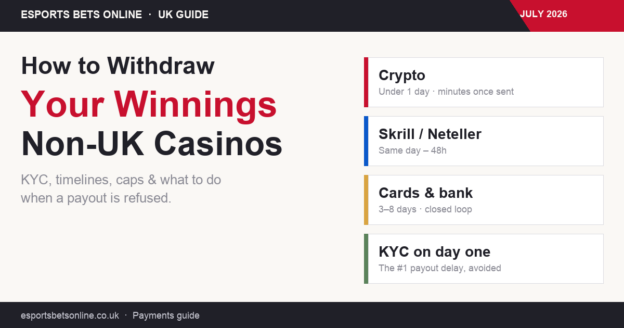
Depositing at a non-UK casino is the easy half. The moment that actually matters — the one that separates a reputable operator from a problem — is when you press “Withdraw”. This guide walks through how withdrawals actually work at non-Gamstop casinos in 2026: the realistic timelines per payment method, the KYC step that delays most first payouts, the withdrawal caps buried in the T&Cs, and what to do if an operator refuses to pay.
Key takeaways
- Complete KYC before you play, not after you win. Verification after a big win is the single biggest cause of delayed payouts — typically adding 24–72 hours when you least want them.
- Withdrawals go back the way the money came in (closed loop). Crypto returns in minutes, Skrill/Neteller same day, cards 3–5 business days.
- Withdrawal caps are the fine print that matters most — many non-Gamstop operators cap payouts at £/€500–£/€10,000 per week. Big win + low cap = months of waiting.
- “Pending period” is not processing time. The 24–48h pending window is a business buffer (and reverse-withdrawal temptation); actual processing starts after it ends.
- If a payout is refused, your escalation path depends entirely on the licence — MGA gives you a real ADR process; Curaçao post-2023 a workable one; anything less, very little.
Withdrawal timelines by payment method — the realistic version
Operator marketing says “instant withdrawals”. Here’s what the full journey actually looks like — from pressing Withdraw to money you can spend — assuming your KYC is already approved:
| Method | Pending period | Processing | Arrival | Total (realistic) |
|---|---|---|---|---|
| Crypto (USDT TRC-20) | 0–24h | Minutes | 1–5 min | Under 1 day |
| Crypto (BTC/ETH) | 0–24h | Minutes–1h | 10–60 min | Under 1 day |
| Skrill / Neteller | 0–24h | 1–24h | Instant once sent | Same day – 2 days |
| Debit card (Visa/MC) | 24–48h | 1–2 days | 3–5 business days | 5–8 days |
| Bank transfer | 24–48h | 1–3 days | 1–3 business days | 3–7 days |
Two things worth internalising from this table: first, the method you deposited with sets your withdrawal speed — that decision was made before you ever won anything (see our deposit methods guide for choosing well up front). Second, the pending period at the start is where most of the variation between operators lives, and it’s the one thing you can sometimes shorten — some sites process VIP or fully-verified accounts with no pending window at all.
KYC — do it on day one, not on payday
Every licensed operator — including every non-Gamstop casino worth using — must verify your identity before releasing funds. This is anti-money-laundering law, not operator whim. The standard pack:
- Photo ID — passport or driving licence, all four corners visible, not expired
- Proof of address — utility bill or bank statement under 3 months old, matching your registration details exactly
- Payment proof — card photo (middle digits and CVV covered), e-wallet screenshot, or crypto wallet ownership where asked
The timing insight most players learn the hard way: verification submitted with a £2,000 withdrawal pending gets human-reviewed under fraud-team scrutiny and takes days. The same documents submitted the day you register, before any money is at stake, sail through in hours. Same documents, wildly different experience.
One more trap: if your registration details don’t match your documents — a nickname instead of your legal name, an old address — the mismatch surfaces at KYC and can void winnings entirely. Register with exactly what your passport says.
Withdrawal limits — the clause that turns wins into instalments
Non-Gamstop operators are not subject to UKGC rules on prompt payment, and many protect their cash flow with per-transaction, weekly, or monthly withdrawal caps. Typical ranges in 2026:
- Budget operators: £/€500–1,000 per week — a £10,000 win takes 10+ weeks to extract
- Mid-tier: £/€2,500–5,000 per week
- Better operators: £/€10,000+ per week, often uncapped for VIP tiers
- Progressive jackpot wins are usually exempt from caps and paid in full — check this clause specifically if you play jackpot slots
Check the withdrawal cap before depositing, in the payments or T&Cs page. If you play with meaningful stakes, the cap matters more than the welcome bonus — a generous bonus at a £500/week-cap site is a worse deal than no bonus at an uncapped one.
Fees — what’s normal and what’s a margin grab
- Normal: free withdrawals to crypto and e-wallets; £/€0–5 flat for bank transfer; one free withdrawal per week with small fees for extras
- Tolerable: 1–2% on card withdrawals (the operator genuinely pays processing costs there)
- Walk away: percentage fees above 3%, “dormancy fees” deducted from pending withdrawals, or fees that only appear after you’ve requested the payout
Also watch currency: if you deposited in GBP but the operator processes withdrawals in EUR, you eat a 2–3% conversion on the way out. Staying in one currency end-to-end (ideally GBP via Skrill, or a stablecoin) avoids the silent double conversion.
Reverse withdrawal — the feature designed against you
During the pending period, most non-Gamstop sites let you “reverse” the withdrawal back into your playable balance with one click. This is the single most profitable button in the operator’s interface — a large share of pending withdrawals never leave the site because the player reversed and replayed them.
Practical defences: withdraw via crypto or e-wallet (short/no pending window means less reversal opportunity), request the withdrawal and log out, and if an operator offers a “lock withdrawal” option in responsible-gambling settings, switch it on. If you find yourself reversing withdrawals repeatedly, treat that as a genuine warning sign — our self-exclusion tools guide covers the layered options that actually work.
When a payout is refused — the escalation ladder
Most refused withdrawals trace back to three causes: incomplete KYC, a bonus term breach (betting above the max stake during wagering is the classic), or a duplicate-account flag. Whatever the stated reason, the process is the same:
- Get the reason in writing. Live chat is fine, but ask for the specific T&C clause they’re relying on, and screenshot everything with dates.
- Exhaust the operator’s internal complaint process — regulators require this first, typically 14–28 days.
- Escalate to the licence authority. This is where the licence you chose at signup pays off or doesn’t: MGA’s Player Support Unit issues binding decisions within ~60 days; Curaçao’s CGCB (post-2023 regime) works but slower; Anjouan or a Costa Rica registration gives you effectively nothing. Our licence comparison guide covers exactly how each regulator’s complaint process works.
- Card deposits have one extra lever: a chargeback via your bank if the operator provably refuses a legitimate payout. Crypto deposits have no equivalent — one honest reason some players still prefer cards despite the slower speed.
FAQs
How long do non-Gamstop casino withdrawals really take?
With KYC done: crypto under an hour to a day, e-wallets same day to 48 hours, cards and bank transfers 3–8 days end-to-end. First withdrawals take longer because verification usually happens then — which is why we recommend verifying at registration.
Can I withdraw to a different method than I deposited with?
Usually not — closed-loop rules send funds back to the deposit source up to the deposited amount. Winnings above that can sometimes go to a second method (typically bank transfer). Paysafecard and some prepaid deposits have no return path at all, so a withdrawal method has to be added and verified separately.
Are winnings from non-UK casinos taxable in the UK?
No — UK residents pay no tax on gambling winnings regardless of where the operator is licensed. One nuance: if you withdraw in crypto and hold it, any rise in the crypto’s value before you sell may be subject to Capital Gains Tax. The winnings themselves remain tax-free.
Why is my withdrawal stuck in “pending”?
The pending window (24–48h at most sites) is standard and not a red flag by itself. It becomes one when it exceeds the operator’s own published timeline, when support gives rotating excuses, or when small withdrawals process fine but large ones stall. At that point, start the written-complaint clock.
Can an operator confiscate winnings for using a VPN?
If the T&Cs prohibit play from your actual location and you masked it, yes — and they generally win that dispute. Play from where you legally can, without location masking, or don’t deposit.
What’s the safest overall withdrawal setup?
Verified account from day one + Skrill or USDT as your deposit/withdrawal loop + an operator with an MGA or post-2023 Curaçao licence and a published weekly cap of £/€5,000 or more. That combination removes nearly every common failure mode.
Bottom line
Withdrawal problems are almost always decided before the first deposit: the method you fund with, the licence behind the site, the cap in the T&Cs, and whether KYC is done early. Get those four right and payouts at reputable non-Gamstop casinos are genuinely fast — often faster than UKGC sites’ 3–5 day card refunds.
For choosing the funding method, see our deposit methods comparison. For judging which licence gives you real recourse, our licence guide. And for the operators we currently track — with licence type and payment options listed — our non-UK casinos overview and non-Gamstop casinos list stay updated.